Card Control at BinaxPay: Smarter Limits, Safer Spending, and Real-Time Protection
-
 BinaxPay Team
 - 26 May, 2026
- 9 mins read
Cards are no longer simple payment tools. They are becoming intelligent financial controls connected to accounts, wallets, security systems, spending rules, and real-time monitoring.
Modern users and businesses do not only want a card that works. They want a card they can control. They want to set limits, freeze usage, receive alerts, manage online payments, protect card data, separate business spending, and react quickly when something looks suspicious.
This is where BinaxPay Card Control becomes important.
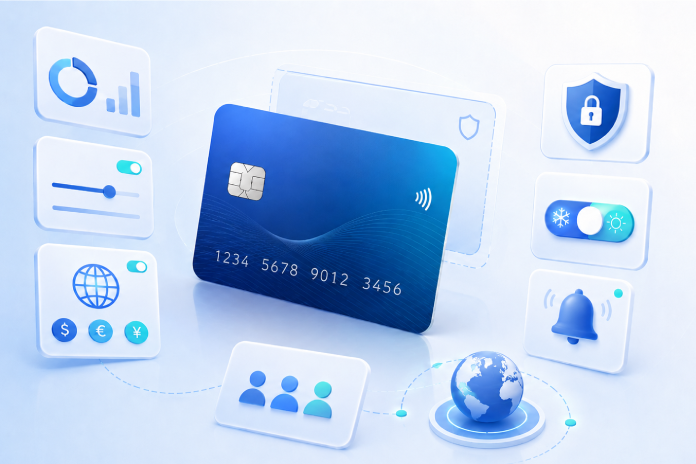
BinaxPay’s card control layer is designed to give users and businesses more visibility, flexibility, and protection over how cards are created, used, monitored, and secured. It supports virtual cards, physical cards, spend limits, merchant controls, freeze and unfreeze actions, PIN reveal, 3-D Secure, real-time alerts, multi-currency spending, business card controls, and integration with account activity.
The goal is simple: give every card stronger control before, during, and after every transaction.
For how virtual and physical programs are issued and managed at scale, see card issuing capabilities: virtual, physical, and program management.
1. Why Card Control Matters
Card payments are fast, global, and convenient. But that same speed can also create risk.
A card can be used online, in-store, across borders, for subscriptions, travel bookings, supplier payments, digital services, business expenses, and daily spending. Without proper controls, card activity can become difficult to monitor and harder to protect.
BinaxPay Card Control helps reduce this risk by giving users direct tools to manage card behavior.
Card controls help protect against:
- Unauthorized spending
- Lost or stolen card misuse
- Suspicious online payments
- Subscription misuse
- Excessive employee spending
- High-risk merchant activity
- Unusual cross-border transactions
- Card testing attacks
- Unclear business expenses
Instead of treating cards as open payment instruments, BinaxPay connects them to a controlled financial environment.
2. Virtual Cards for Digital Spending
Virtual cards are one of the most useful tools in modern fintech because they allow users and businesses to create card credentials without waiting for a physical card.
With BinaxPay, virtual cards can be used for online payments, subscriptions, vendor payments, travel bookings, advertising platforms, software tools, marketplaces, and business expenses.
Virtual cards help users:
- Create cards quickly
- Separate spending by purpose
- Reduce exposure of main card details
- Control online subscriptions
- Manage vendor payments
- Track digital spending clearly
- Pause or replace a card without affecting the full account
For businesses, virtual cards are especially powerful. A company can create separate cards for advertising, software, travel, procurement, or team expenses. If one card needs to be frozen or replaced, other cards can continue operating normally.
3. Physical Cards for Everyday Use
Physical cards remain important for in-person payments, travel, hotels, transport, restaurants, retail purchases, and business spending.
BinaxPay supports physical card access alongside virtual cards, giving users one connected card experience for both digital and real-world payments.
Physical cards support:
- In-store purchases
- Travel spending
- Hotel and transport payments
- Business expenses
- Everyday personal spending
- Supported ATM-related usage
- Global merchant acceptance where supported
For users and companies operating internationally, physical cards remain essential because not every payment happens online.
4. Spend Limits and Usage Rules
One of the strongest parts of card control is the ability to define how a card can be used.
BinaxPay Card Control supports spend rules that help users and businesses manage transaction behavior before spending happens.
Spend controls can include:
- Per-transaction limits
- Daily limits
- Monthly limits
- Card-level spending caps
- Business expense limits
- Employee spending controls
- Travel budget controls
- Project-based spending rules
This gives users and companies better financial discipline. A card can be created for a specific purpose and limited to that purpose.
For example, a business can create one card for advertising, one for software subscriptions, one for travel, and one for procurement. Each card can have its own spending logic, making financial activity easier to track and safer to manage.
5. Merchant and Category Controls
Not every card should work everywhere.
A travel card may not need to work for gaming websites. A software subscription card may not need to work in physical retail stores. An employee expense card may need to be limited to approved merchant categories.
BinaxPay’s card control model supports merchant and category-based restrictions to help align card usage with its intended purpose.
Merchant controls can help protect:
- Company spending policies
- Department budgets
- Subscription management
- Procurement activity
- Travel expense rules
- Employee card usage
- Risky or unauthorized merchant activity
This turns the card into more than a payment method. It becomes a controlled spending tool.
6. Freeze and Unfreeze Controls
Freeze and unfreeze controls are among the most practical card security features.
If a user misplaces a card, sees suspicious activity, wants to pause spending, or needs to review employee card usage, the card can be frozen. If the issue is resolved, the card can be unfrozen.
BinaxPay freeze and unfreeze controls help users respond quickly to:
- Lost cards
- Suspected card compromise
- Unusual transactions
- Temporary spending pauses
- Employee spending reviews
- Travel-related security concerns
- Subscription disputes
The benefit is immediate action. Users do not need to wait for fraud to happen. They can pause the card first, review the situation, and then decide the next step.
7. 3-D Secure for Online Payments
Online card payments need stronger protection because the card is not physically present.
3-D Secure adds an authentication layer to online card payments, helping verify that the transaction is being performed by the legitimate cardholder.
BinaxPay supports 3-D Secure as part of its card security stack.
3-D Secure helps protect:
- Online purchases
- Subscription payments
- Travel bookings
- E-commerce transactions
- High-risk digital checkouts
- Card-not-present payments
This makes online card usage safer because the transaction does not rely only on card number, expiry date, and security code. Authentication can be added when needed.
Strong authentication, risk rules, and authorization controls are explained in 3DS, risk rules & card security.
8. PIN Reveal for Secure Card Access
PIN access is important for physical card usage.
BinaxPay supports secure PIN reveal, allowing users to access their card PIN when needed while keeping sensitive card information protected.
PIN reveal supports:
- Physical card usage
- In-person payments
- Supported ATM-related access
- Safer cardholder control
- Reduced need for insecure PIN storage
The PIN should always be handled securely. BinaxPay’s card control experience helps users access it only when needed.
9. Real-Time Alerts and Card Activity Visibility
Card fraud and misuse can happen quickly, so users need fast visibility.
BinaxPay supports real-time card activity alerts, helping users and businesses see important card events as they happen.
Real-time alerts can support:
- Transaction notifications
- Suspicious activity awareness
- Spending confirmations
- Failed payment visibility
- High-value transaction alerts
- Merchant activity visibility
- Unusual pattern detection
This gives users more control because they do not need to wait for a monthly statement to understand what happened. Important card activity can be reviewed much earlier.
For businesses, alerts also help finance teams monitor spending, detect unusual behavior, and respond faster.
10. Tokenized Card Data and Safer Digital Payments
Tokenization helps protect card data by replacing sensitive card details with secure digital tokens.
This is important for online payments, wallet provisioning, merchant card storage, subscription payments, and card-on-file transactions.
BinaxPay’s card infrastructure is designed with secure card data handling and tokenized payment principles.
Tokenization helps protect:
- Online purchases
- Digital wallet usage
- Card-on-file payments
- Subscription payments
- API-based card workflows
- Sensitive card credentials
Tokenization does not remove every risk, but it reduces unnecessary exposure of raw card details.
Foundational card identifiers and tokenization concepts are covered in card issuing basics (BIN, PAN, CVV, tokenization).
11. Multi-Currency Spending
BinaxPay’s card ecosystem is connected to multi-currency financial activity.
This is important because users and businesses often spend across different countries, currencies, merchants, and platforms. A card may be used for international travel, online services, supplier payments, subscriptions, or global commerce.
Multi-currency card usage helps support:
- International spending
- Travel payments
- Global online purchases
- Subscription platforms
- Business expenses
- Supported currency management
- Clearer transaction records
When cards connect to wallets, FX, payments, and account activity, users gain a clearer view of how money is being spent across markets.
12. Business Card Controls for Teams
Business cards need stronger control than personal cards because companies manage spending across employees, departments, branches, contractors, partners, and projects.
BinaxPay supports business card control features that help companies manage team spending with better structure.
Business card controls can support:
- Employee expense cards
- Department cards
- Project-based cards
- Supplier payment cards
- Travel cards
- Procurement cards
- Controlled team spending
- Card activity reporting
With spend limits, merchant restrictions, alerts, and freeze controls, businesses can give teams access to spending tools without losing visibility.
13. Card Control for Reconciliation
Card spending must be easy to understand after the transaction happens.
Users and businesses need to know what was spent, where it was spent, who used the card, what currency was involved, whether the transaction succeeded, and how the activity connects to the account.
BinaxPay connects card activity with wider account, wallet, payment, FX, and transaction records.
This supports:
- Transaction history
- Merchant details
- Cardholder activity
- Currency tracking
- Expense records
- Failed payment review
- Spending reports
- Audit trails
- Account visibility
Without reconciliation, card spending becomes difficult to manage. With clear records, card activity becomes easier to review, report, and control.
Matching card activity to ledger and settlement records is part of ledger consistency, reconciliation, and settlement.
14. Card Fraud Monitoring and Risk Signals
Modern card security must look beyond the transaction amount.
Fraud monitoring can review patterns such as transaction velocity, merchant behavior, device signals, location patterns, spending history, and unusual usage.
BinaxPay’s card control layer is designed to support risk monitoring across card activity.
Risk monitoring can help detect:
- Unusual online spending
- Rapid card testing behavior
- Suspicious merchant activity
- Transaction velocity spikes
- High-risk location patterns
- Abnormal purchase timing
- Repeated failed attempts
- Unusual cross-border usage
Card fraud often appears as a pattern. One transaction may look normal, but several fast transactions from a new merchant, region, or device can indicate risk.
Broader monitoring and risk intelligence approaches are outlined in AI-enhanced monitoring for fraud and risk.
15. Card Control as a Trust Layer
Card control is becoming one of the most important layers in modern finance.
Cards are no longer only about payment access. They are about trust, visibility, control, and protection.
BinaxPay brings these controls into one connected card environment by combining:
- Virtual cards
- Physical cards
- Spend limits
- Merchant controls
- Freeze and unfreeze
- 3-D Secure
- PIN reveal
- Real-time alerts
- Tokenized card data
- Multi-currency spending
- Business card controls
- Risk monitoring
- Account and wallet integration
This makes the card part of a wider financial security system, not just a plastic or digital payment credential.
Conclusion
Card control is now a core requirement for modern financial platforms.
Users want safer spending. Businesses want better team expense control. Platforms want embedded card experiences. Everyone wants faster visibility, stronger protection, and more flexible payment tools.
BinaxPay Card Control gives users and businesses the ability to issue, monitor, restrict, pause, authenticate, and manage cards from one connected financial environment.
The value is not only the ability to spend.
The real value is the ability to spend with control.